Structural Drying in Leon Valley, TX
IICRC-certified drying to industry moisture standards. Serving Leon Valley and all of Bexar County 24 hours a day, 7 days a week.
Expert Structural Drying Serving Leon Valley
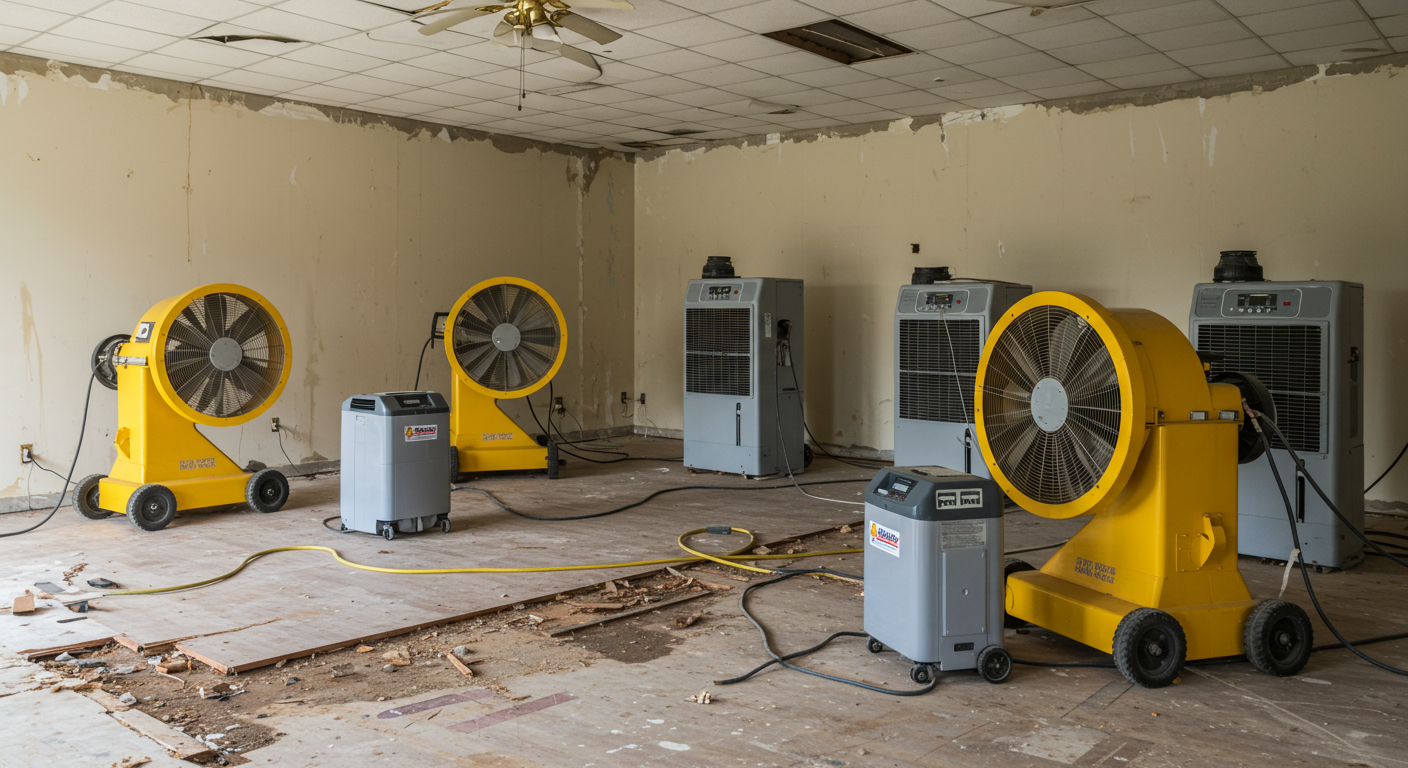
After water is extracted from a Leon Valley property, the work has just begun. Leon Valley's homes — with their mid-century slab homes, mature trees that frequently damage roofs during storms, and dense residential development with limited drainage infrastructure — contain building materials that absorb and hold moisture deep inside structural assemblies, invisible to the naked eye. Surface drying is not enough. Fast Dry Cleanup & Restoration uses low-grain refrigerant (LGR) dehumidifiers, desiccant dehumidifiers, injectidry wall cavity systems, and specialty floor mat drying equipment to pull moisture from inside walls, beneath floors, and within structural cavities until every monitored point reaches the established dry standard.
The dry standard we target is not arbitrary — it's determined by the species of materials present, their pre-loss moisture content, and the IICRC S500 standard for water damage restoration. A wood-framed wall in Leon Valley has a different target than a concrete block wall in a lower level. We perform psychrometric calculations to design an equipment layout that achieves the most efficient drying path for your specific Leon Valley property.
Structural drying in Leon Valley requires daily monitoring and equipment adjustment as materials dry at different rates. Our technician visits your property each day, records moisture readings at every monitored point, adjusts equipment positions based on the data, and provides you with a written progress update. We do not remove equipment until every point in the structure meets its established dry standard — and we document the entire process for your insurance carrier.
Local Knowledge — Leon Valley, Bexar County
Leon Valley's ambient humidity levels mean passive drying — opening windows or running household fans — is rarely effective and often counterproductive during humid Texas weather. Leon Valley sits within the Leon Creek watershed and is vulnerable to flash flooding during storms. Creek overflow and street flooding affect several neighborhoods during major rain events each year. Our structural drying crews are trained in psychrometric science and IICRC S500 methodology, and they bring equipment appropriately sized for the loss — not whatever happens to be available.
Our Structural Drying Process in Leon Valley
Moisture Mapping & Baseline Documentation
Before any drying equipment is placed, we map every wet material and record baseline moisture readings throughout the structure. This establishes the starting point and allows us to track drying progress accurately day by day.
Psychrometric Calculation & Equipment Design
Using temperature, humidity, and wet material volume data, we calculate the exact number and type of dehumidifiers and air movers needed to achieve efficient drying in your specific property. Equipment is sized to the loss, not guessed at.
Equipment Deployment
LGR dehumidifiers, axial and centrifugal air movers, injectidry wall cavity systems, and floor mat systems are positioned according to the drying plan. We ensure every wet zone has targeted drying airflow and moisture removal.
Daily Monitoring & Adjustment
A technician visits daily, records moisture readings at every monitoring point, reviews psychrometric data, and adjusts equipment placement and settings based on drying progress. No guessing — every decision is data-driven.
Dry Standard Verification
When moisture readings across all monitored points reach their established targets, we perform a final moisture map to verify complete drying. Only after all points pass do we begin equipment removal.
Final Documentation & Clearance
We compile the complete drying documentation — baseline readings, daily logs, equipment records, and final moisture map — and provide it to you and your insurance carrier. This documentation is your proof that drying was completed to industry standards.
What Our Leon Valley Structural Drying Service Includes
Warning Signs You Need Structural Drying in Leon Valley
Why Leon Valley Homeowners Must Act Immediately
In Leon Valley's warm climate, structural materials that remain wet for more than 48 to 72 hours will almost certainly develop mold. Wet subfloor OSB panels delaminate and lose structural integrity. Hardwood floors cup, buckle, and crack permanently. Drywall crumbles and cannot be patched — only replaced. Insulation saturated for more than 24 hours must typically be removed. Professional structural drying is not optional — it is the difference between a successful restoration and a full reconstruction project.
Common Causes of Structural Drying in Leon Valley
Frequently Asked Questions — Structural Drying in Leon Valley
How long does structural drying take in a Leon Valley home?
Most residential structural drying projects in Leon Valley take between 3 and 5 days with professionally sized equipment deployed promptly. Larger losses, heavily saturated materials such as hardwood over concrete, or structural complexity can extend this timeline. We monitor daily and communicate progress throughout.
Can I run fans and dehumidifiers myself instead of hiring professionals in Leon Valley?
Consumer-grade fans and dehumidifiers lack the airflow velocity and moisture removal capacity needed to dry structural materials in Leon Valley homes. Household equipment can take weeks to dry what professional equipment addresses in days — if it reaches dry standard at all. During that extended drying window, mold develops and materials degrade beyond salvage. Professional equipment is significantly more cost-effective.
How do I know when my Leon Valley home is actually dry after water damage?
The surface feeling dry is not sufficient — what matters is the moisture content inside structural materials as measured with calibrated professional meters and compared against established dry standards for each material type. Walls can feel dry to the touch while remaining dangerously wet inside. We provide written daily moisture readings and a final clearance document for every Leon Valley project.
Will structural drying damage my hardwood floors in Leon Valley?
Drying hardwood floors quickly with professional equipment actually reduces damage — the longer hardwood stays wet, the more it cups and buckles. We use specialty floor mat drying systems that accelerate moisture removal from hardwood without the heat or airflow that can cause surface checking. Early professional intervention saves hardwood floors that waiting would destroy.
Do I need to leave my Leon Valley home during structural drying?
In most cases, no. The drying equipment is loud but the home remains safe to occupy for most structural drying projects. We work around your schedule and set up equipment to minimize disruption to the living areas of your Leon Valley home. If remediation of mold or sewage contamination is required alongside drying, temporary relocation may be recommended.
How is structural drying different from just extracting the water in Leon Valley?
Water extraction removes standing and surface water — the bulk of the visible water. Structural drying then removes the moisture that has absorbed into building materials: the water inside the walls, under the floors, and in the ceiling cavities. These are two sequential phases, and both are necessary for a complete restoration of your Leon Valley property.
We Serve Every Neighborhood in Leon Valley
Structural Drying Also Available in Nearby Communities
Get Help in Leon Valley
Leon Valley Response Info
More Services in Leon Valley
All Services
Need Structural Drying in Leon Valley?
Our crew can be at your Leon Valley property in 30–45 min. Call now for immediate dispatch or request a free inspection.